
List Comprehensions
In this lesson, list comprehensions are introduced, a very expressive way to describe the contents of lists with syntax similar to what we are used to for describing sets in mathematics. Thanks to list comprehensions, algorithms will have fewer levels of indentation and will be more readable.
Comprehension Notation
Until now, we have described lists using extension notation, that is, by giving a list with all the members of the set:
>>> l1 = []
>>> l2 = [10, 30, -12]
>>> l3 = ['cat', 'dog', 'turtle']
Extension notation is useful for lists with a few elements, but when there are many elements or their number is unknown, it can no longer be used and code fragments with loops and appends must be written to create them. For example, this fragment creates the list squares with all the numbers i² for i from 0 to n - 1:
squares = []
for i in range(n):
    squares.append(i * i)
Comprehension notation allows creating lists through an expression depending on a variable, for a domain of values of that variable. For example, the list squares could be written like this with comprehension notation:
squares = [i * i for i in range(n)]Surely you find this definition much simpler than the three lines above and, moreover, you probably recognize this notation as a copy of what is used in mathematics to describe sets:
Additionally, comprehension notation also allows adding a condition for the elements included in the list. For example, the list of all squares between 0 and 20 that end in a 6 could be described like this:
>>> [i * i for i in range(21) if i * i % 10 == 6]
[16, 36, 196, 256]
Therefore, list comprehension notation has four parts:
- an expression that determines the values of the list,
- a variable,
- a sequence,
- and a condition (optional).
This is the scheme:

Underneath, Python converts a list comprehension into a loop, a conditional, and an append: The list comprehension
lst = [i * i for i in range(21) if i * i % 10 == 6]is thus equivalent to
lst = []
for i in range(21):
    if i * i % 10 == 6:
        lst.append(i * i)
but probably memory management with comprehensions is more efficient.
Comprehensions can have more than one for, which are executed nested. For example, we could calculate all possible sums of the values of two six-sided dice in ascending order like this:
>>> sorted([die1 + die2 for die1 in range(1, 7) for die2 in range(1, 7)])
[2, 3, 3, 4, 4, 4, 5, 5, 5, 5, 6, 6, 6, 6, 6, 7, 7, 7, 7, 7, 7, 8, 8, 8, 8, 8, 9, 9, 9, 9, 10, 10, 10, 11, 11, 12]
Occasionally, we will also want to create lists of tuples:
>>> [(a, b) for a in range(3) for b in 'cat']
[(0, 'c'), (0, 'a'), (0, 't'), (1, 'c'), (1, 'a'), (1, 't'), (2, 'c'), (2, 'a'), (2, 't')]
Often list comprehensions work very well with built-in functions like max, min, and sum. For example, the function we made for the dot product can be written more concisely like this:
def dot_product(x, y):
    """Returns the dot product of two vectors of the same size."""

    return sum([x[i] * y[i] for i in range(len(x))])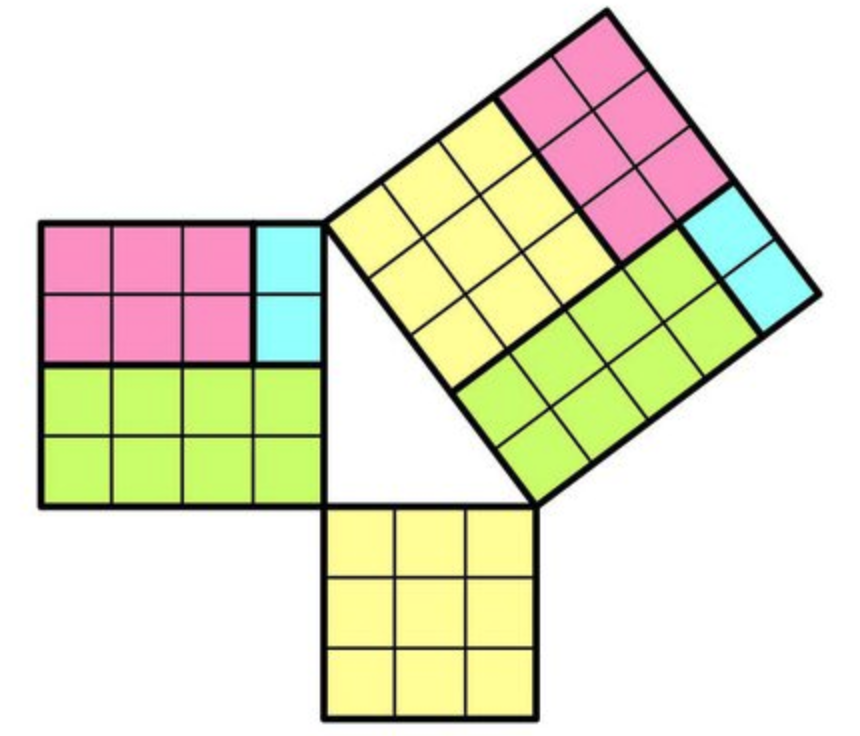
One last example: In mathematics, a Pythagorean triple is formed by three natural numbers
A list comprehension for Pythagorean triples could be written like this:
>>> n = 25  # maximum length
>>> [   (a, b, c)
...     for a in range(1, n + 1)
...     for b in range(a, n + 1)
...     for c in range(b, n + 1)
...     if a**2 + b**2 == c**2
... ]
[(3, 4, 5), (5, 12, 13), (6, 8, 10), (7, 24, 25), (8, 15, 17), (9, 12, 15), (12, 16, 20), (15, 20, 25)]
There are more efficient methods to generate Pythagorean triples, but this example highlights the capabilities of list comprehensions.

Jordi Petit
Lliçons.jutge.org
© Universitat Politècnica de Catalunya, 2026